A rich and exuberant “Romeo and Juliet” opens the season for Ballet West
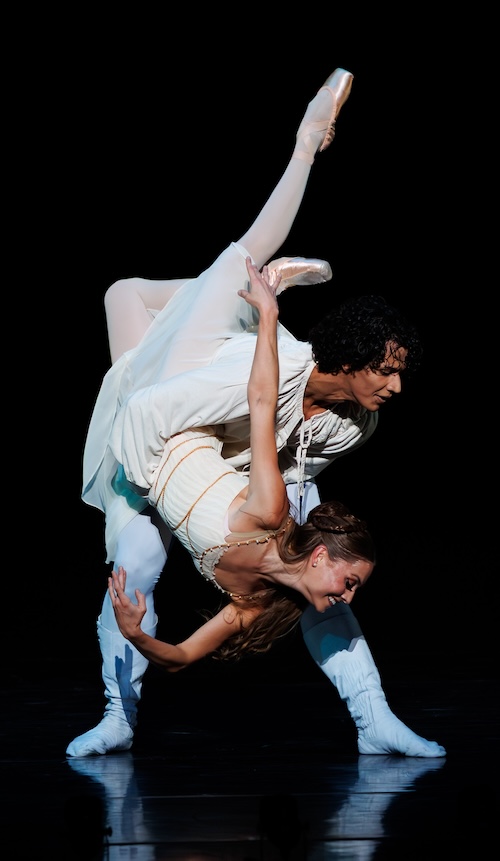
Ballet West opened their 2025-26 season at the Capitol Theatre Friday night with Romeo and Juliet, a retelling of William Shakespeare’s tragic romance of star-crossed lovers from feuding families, choreographed by Michael Smuin with Serge Prokofiev’s iconic score.
Rather than foreshadowing the eventual misfortune, Smuin’s take on Romeo and Juliet explores the spark and attraction of infatuation and the comedy and friendship of the characters before leading to the heartbreaking ending. Ballet West first performed this Romeo and Juliet staging in 1988, and it was a company staple throughout the 1990s. Ballet West last revived this production in 2022.
Romeo and Juliet is the perfect production to showcase the talent and artistry of Ballet West. The choreography is challenging, technical, and elegant, and with very little pantomime it requires strong acting to carry the story forward. From the leads through the company members in street and party scenes, the dancing had and skillful timing and striking depth of character.
Amy Potter was a joyful Juliet, full of youthful exuberance. Her movements are sharply defined and regal, which served to accent the playful actions of the character. Potter has stunning port de bras, and whether tricking her nurse, embracing her love, or collapsing on a funeral bier, her arm movements always perfectly tell the story.
Hadriel Diniz performed Romeo with a dreamy romanticism. His graceful gestures brought a passionate balance to Potter’s active Juliet. Their partnering in the balcony scene pas de deux was sublime, with demanding turns and lifts that seemed effortless.
Smuin’s choreography in the first two acts highlights physical humor to build the characters. This was most prominent with William Lynch as Mercutio and Loren Walton as Benvolio. The two tease, flirt, boast, and fight with Capulets through exaggerated but dazzling pirouettes and leaps.
This comedy wouldn’t be as strong without Adrian Fry’s charismatic performance as Tybalt. As the foil to Lynch and Walton and the recipient of their jabs, Fry’s simmering rage heightened the impact of their jokes. Fry also has the most robust fight choreography which was attention-grabbing and thrilling.
In addition to big, passionate pas de deux, Smuin also designed challenging and captivating choreography for many of the other male characters. Diniz, Lynch, and Walton share a mischievous and arrogant pas de trois before the Capulets’ ball, which the footwork and jumps of the choreography one up each other as the scene progresses. The synchronization of their movements shows the fellowship between the friends. Fry also partners beautifully with Nicole Fannéy as Lady Capulet in a scene that vividly reveals their love affair to the audience while hiding it from Lord Capulet as the trio sinuously move across the stage.
Sets by William Pitkin were minimalist, but effective in setting the location and tone. This was artfully accomplished in the final crypt scene with a moody backdrop and an ornate gate suspended from above to enhance the feeling of being underground. Costumes by David Heuvel identified the different families through an extensive and rich color palette.
The score by Sergei Prokofiev is a vibrant emotional partner to the ballet’s choreography, and the Ballet West Orchestra played with a lush, focused sound under music director Jared Oaks.
Ballet West’s Romeo and Juliet continues through November 1. balletwest.org