Classical Music
Hindoyan and Ioudenitch shine in Russian and American works with Utah Symphony
Conductor Domingo Hindoyan returned to the Abravanel Hall podium this weekend […]
Pintscher returns to Utah Symphony with luxuriant Ravel and his own compelling concerto
After a ten-year absence, composer and conductor Matthias Pintscher was back […]
Theater
Critic’s Choice 2025-26
Moravec: The Shining. Utah Opera. October 11–19. Stephen King’s horror classic […]

Ballet review
Ballet West opens season with a revival of its lavish and entertaining “Dracula”
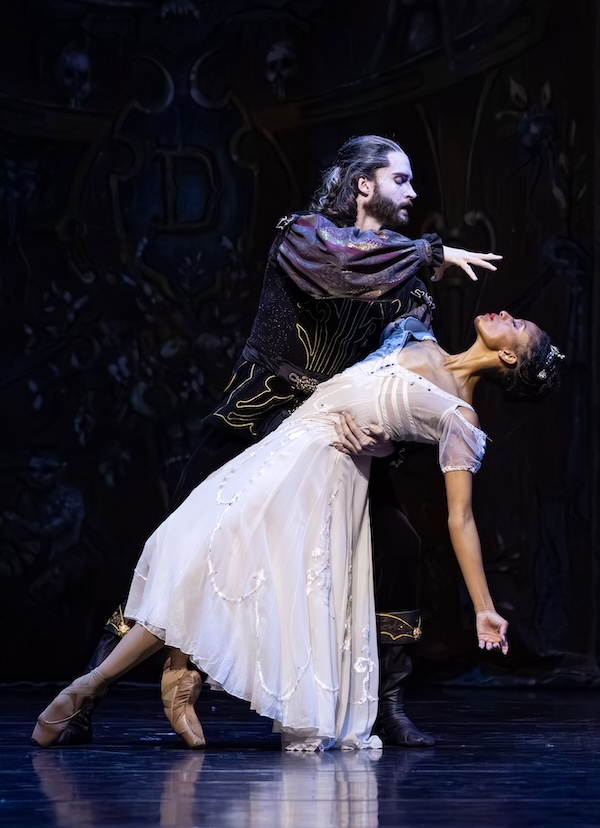
Ballet West opened its 2026-27 season at the Capitol Theatre on Friday with Dracula, Ben Stevenson’s highly celebrated portrayal of the gothic tale.
The familiar characters, combined with a lavish production, make this an accessible and entertaining ballet for newcomers. Originally premiered in Houston, Texas in 1997, it has proven to be a popular ballet in Utah, and this is the third time Ballet West has performed it since 2021.
Stevenson’s Dracula does not tell the same story as Bram Stoker’s 1897 novel, but instead a series of scenes showcasing his undead brides, the abduction of a young woman from the nearby village, and Dracula’s death at the hand of the villagers.
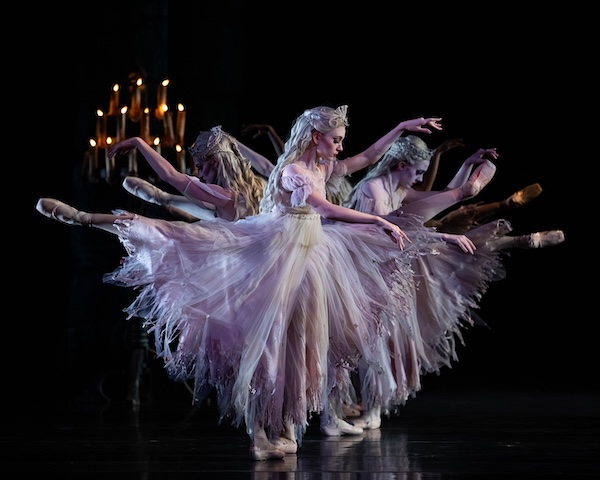
Stevenson makes Dracula feel akin to other great story ballets by approaching it not only through grandeur and scale, but also by highlighting similarities through other classics. The initial, spectral appearance of his brides calls to mind the haunting Wilis from Giselle, but Stevenson’s choreography is more mutable, as the corps of 18 dancers quickly pivots from languid, elegant balances to crisp, angular arm movements.
Their synchronization was hypnotic, and the dancers took advantage of multiple levels of space, not only through complex diagonal and circular sequences on the stage, but through flying brides darting high above.
Adrian Fry approached the role of Dracula with a restraint and seriousness that lent dramatic depth to an otherwise two-dimensional character. His technique was clean and precise, which made for a very regal portrayal. This restraint was beautifully contrasted with Nicole Fannéy’s Flora, a girl kidnapped from the village, whose high jumps and long extensions emanated fear and drama.
Act 2 also extensively features the corps de ballet, including the male dancers, with many folk dances to capture the excitement of village life. Stevenson’s choreography uses many props, including a ribbon dance for the women, and an athletic sequence with staffs for the men. Fannéy’s return to the village, transformed into one of the vampire brides, was instrumental in shifting the mood as she pivoted through stretching and released movements that built tension.
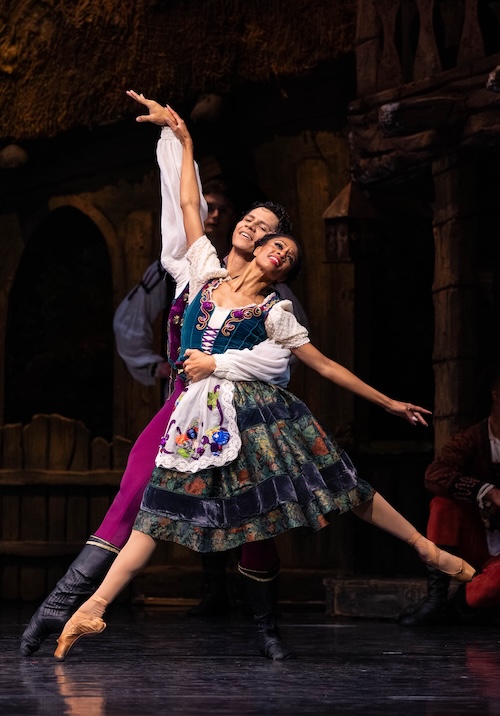
Principals Katlyn Addison and Hadriel Diniz had charming chemistry as Svetlana and Frederick, and truly felt like a young couple in love. Their main pas de deux was light and joyous with effortless lifts and pirouettes. Both of their solos featured complex turns, with a long sequence of pirouettes at the center from Diniz and alternating turns en pointe and on flexed flat feet from Addison.
Back in the castle, William Lynch skillfully portrayed the frustration and madness of Dracula’s assistant Renfield through the repetition of sharp, exaggerated jumps that quickly crumpled to the floor in contraction. The theatrical climax felt more comedic than scary, with a complex chase scene unfolding as villagers avoid the brides, Renfield, and Dracula who pursue and recapture Svetlana. In a flurry of flying and pyrotechnics, the vampires are vanquished and Addison and Diniz have time for one final tender moment.
The sets by Thomas Boyd are immersive and opulent, with crumbling castle walls and ancient tapestries to build the haunting atmosphere. Costume design by Judanna Lynn reinforces the army of vampire brides through their ashen appearance, which makes the rich colors on the human characters costumes even more vibrant.
The Ballet West Orchestra under music director Jared Oaks added striking nuance to the evening with their performance of multiple works by Franz Liszt arranged by John Lanchbery. Piano soloist Vedrana Subotic stood out in her work within the orchestra, but also in multiple piano solos through the evening.
Ballet West’s Dracula continues through October 31. balletwest.org
Calendar
October 28
Ballet West
Dracula
7:30 p.m. Lawson Capitol Theatre
[…]
Dance
Ballet West wraps season with a spring bouquet of new works
Ballet West explores the energy and variety of brand new dance […]
Ballet West goes east for a high-stepping Broadway and Beyond program
Ballet West captured an energetic New York state of mind with […]