Fine singers done in by Utah Opera’s disastrous Dummy’s Guide to “Fidelio”
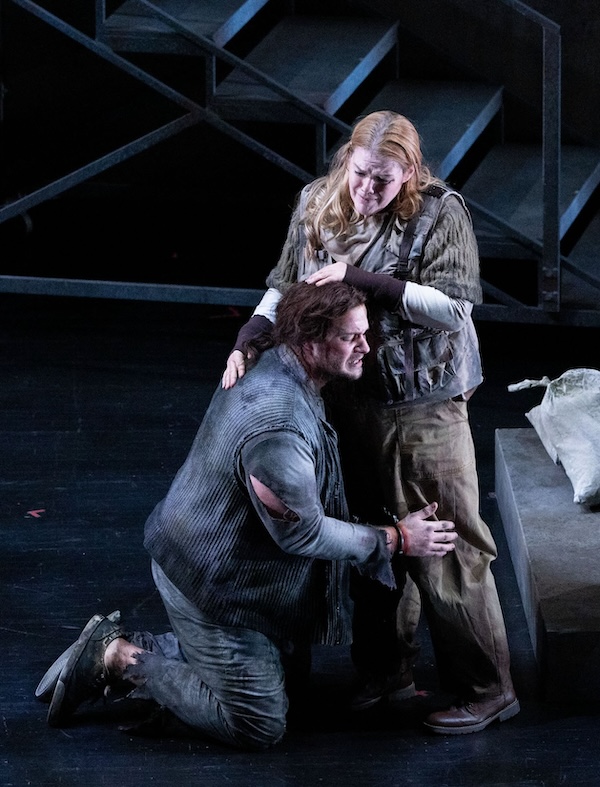
Utah Opera’s new production of Beethoven’s Fidelio, which opened Saturday night in the Capitol Theatre, is notable for some fine vocal performances. Yet the worthy vocalism is done in by an utterly disastrous staging that shows interventionist opera direction at its worst.
First and foremost, stage director Tara Faircloth jettisons the opera’s spoken dialogue for this production and replaces it with her own selections of poetry and speeches that are related to the ideals expressed in the opera — a world free from tyranny; the destructiveness of racism, hatred injustice and revenge; and the power of love to conquer adversity.
The new interpolated texts are taken from the writings of several, mainly 20th century authors and activists, including Langston Hughes, Edna St. Vincent Millay, Gandhi, Nelson Mandela and Martin Luther King, Jr.
While the sentiments may be noble, the narrative interruptions are jarring and disrupt the action and flow of the story.
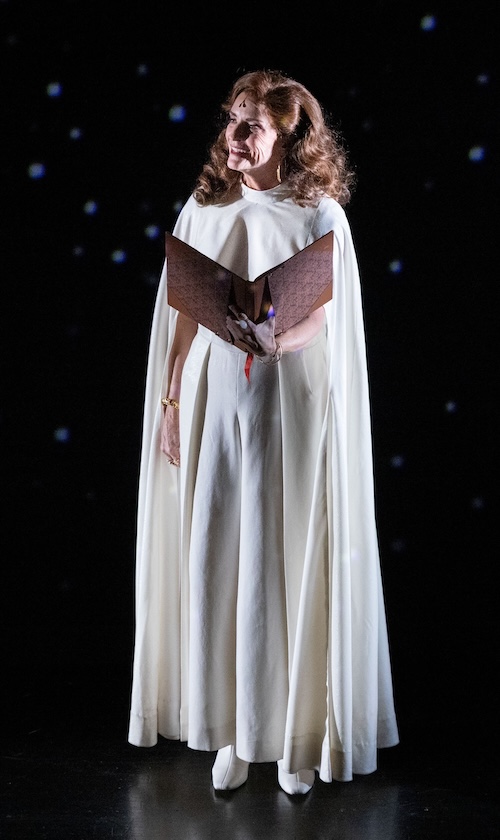
Making matters worse, these texts are delivered by a new female character, created by Faircloth, whom she calls “The Oracle”— a figure robed in a flowing, white diaphanous gown. Perhaps not insignificantly, this character was played by Utah Symphony|Utah Opera board member Sharlene Wells.
According to director Faircloth, in her comments in the program notes, this new character and narrative were employed to eliminate the spoken dialogue. Why? Because Fidelio is in German and, therefore, “is a challenge…for an American opera audience to really engage with and enjoy.”
This is utter nonsense. Faircloth not so subtly implies that American operagoers are too stupid and linguistically challenged to comprehend and appreciate an opera written in a foreign language, even in the age of the ever-present supertitles. She needs to re-evaluate her directorial philosophy, or better yet, stop directing operas altogether.
Faircloth’s condescending attitude to Fidelio and the Utah audience was manifest from the curtain opening night. During the Overture, each character took a turn standing onstage under a spotlight with their name and who they are projected onto a screen. When Leonore is spotlighted, she is seen finishing changing into men’s clothing for her role as Fidelio. All of this is wholly unnecessary and brings nothing of worth to the story.
Fortunately, the musical side of this production was better served and offers some exceptional singing, particularly Wendy Bryn Harmer as Fidelio/Leonore. Harmer has a pure soprano that allows her to handle the daunting vocal demands of her role with ease. At Saturday’s performance, she sang with clear enunciation and expressive execution, delivering her lines with self-assured confidence.
In her big first-act aria, “Abscheulicher! Wo eilst du hin?,” Harmer showed off her vocal prowess with her power and fluid, seamless singing. Her commanding presence and sincerity were manifest in her resolve to rescue her husband, Florestan. Harmer blended in well with the other singers in her ensemble pieces, especially the charming Act I quartet “Mir ist so wunderbar,” sung with Marzellina, Rocco and Jaquino.
Thomas Kinch (replacing the originally cast Limmie Pulliam) gave a strong account of the unjustly imprisoned Florestan. The young tenor showed palpable depth of emotions, from despair (“Gott! Welch’ Dunkel hier!”) to happiness as he has a vision about his blissful life with Leonore (“In des Lebens Frühlingstagen”).
When Florestan and Leonore are reunited, Kinch and Harmer gave a vocally compelling account of the duet “O namenlose Freude!” Their vibrant voices blended beautifully together as they sang with tonal strength and heartfelt expression.
Another standout was Zachary Nelson as the cruel commandant of the prison, Don Pizarro. Nelson has a distinctive baritone that has depth as well as finely honed expressiveness, and he sang his part with conviction, showing off his considerable acting chops. He teemed with unbridled fury in his Act I aria, “Ha! Welch ein Augenblick!,” as he laid out his plans to revenge himself on Florestan and reveled in his perceived power over his enemies.
Raymond Aceto, replacing David Soar, sang the part of the jailer Rocco. He brought compassion to his portrayal, recoiling at Don Pizarro’s orders to kill Florestan and emphasizing his humanity even within his deplorable position.
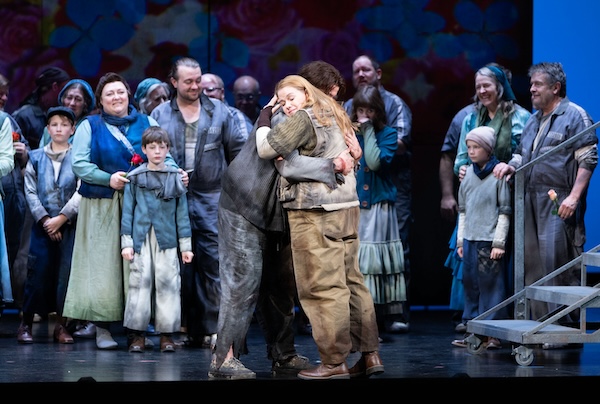
There was also affecting tenderness in his interactions with his daughter Marzellina, sung by Utah Opera resident artist Stephanie Chee. The young singer showed potential at Saturday’s performance, but her voice tended to be breathy and overshadowed by the others. She also struggled reaching high notes, and when she did they were unfortunately shrill.
Fellow resident artist Rodney Sharp II sang the small part of Don Fernando, the king’s minister who arrives unexpectedly at the prison and foils Don Pizarro’s attempt to murder Florestan. Similarly Sharp’s voice was sorely lacking in power and projection, and he was often completely drowned out by the orchestra.
Jaquino was to have been sung by another resident artist, Aaron McKone, but illness prevented him from doing so. Instead, Joshua Lindsay sang the part from the side of the stage while McKone, wearing a face mask, mimed his part.
The Utah Opera Chorus once again gave a fabulous performance, especially the men in the prisoners’ chorus “O welche Lust,” singing it with bittersweet longing and with a faint glimmer of hope.
Benjamin Manis’s conducting provided little help to this disappointing show. While there was some fine solo moments by the Utah Symphony members, the orchestra as a whole sounded lackluster and undefined under his direction.
Utah Opera’s Fidelio runs through January 25. utahopera.org
Leave a Comment