Utah Opera soars with season-opening “Zorro”
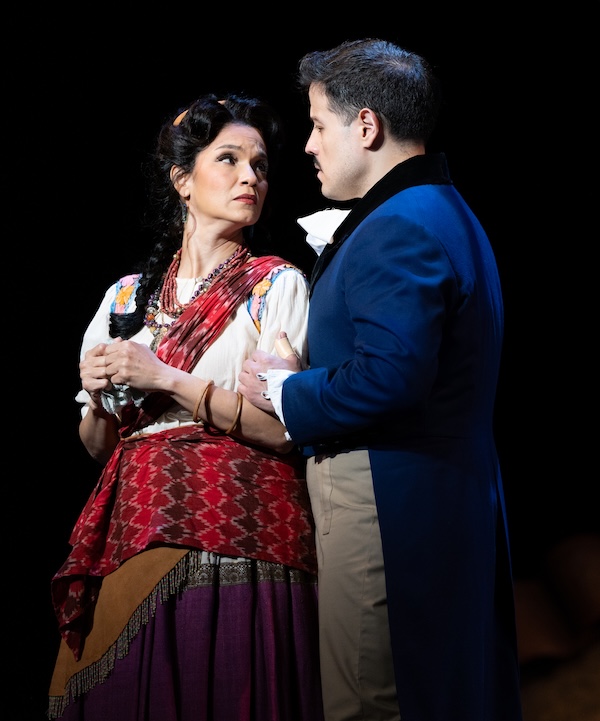
Utah Opera opened its season Saturday with a swashbuckler, Héctor Armienta’s Zorro. Premiered in 2022 by Fort Worth Opera, Armienta’s opera is based on the early 20th-century story The Curse of Capistrano by pulp writer Johnston McCulley, a work that spawned several movies as well as a short-lived television series from the 1950s.
The opera’s libretto, which Armienta also wrote, follows the original story fairly closely. Set in the early 1800s in Los Angeles, in what was still Spanish California, it tells the tale of Diego de la Vega, a wealthy landowner who has spent several years in Spain. When he returns home, he discovers that the mayor, Octavio Rivera y Moncada, rules by fear and oppression. In his disguise as Zorro, de la Vega vows to avenge Moncada’s cruelty and restore peace and prosperity for the townsfolk as well as for the indigenous people living there.
Armienta’s score is unabashedly romantic, with soaring melodies and lushly textured orchestration. He also infuses the music with Latin rhythms and melodic motives that help to underscore the Spanish setting of the story. The vocal writing is very reminiscent of Puccini’s glowing melodies and fiery passion, and, consequently, is a wonderful vehicle for the singers.
Leading off the fine, mostly Hispanic, cast assembled for this production is tenor César Delgado as Diego de la Vega. Delgado’s voice is clear and vibrant and reaches the upper register effortlessly, while still maintaining a full-bodied rich sound. As an actor, he embodied the duality of his character convincingly, alternating between his well-mannered, upper class gentility and his alter ego, the daring avenging angel, Zorro.
Soprano Zulimar López-Hernández as de la Vega’s childhood friend Ana Maria Soza, is the perfect counterpart to Delgado, both as a singer and actor. Her voice shimmers with crystal clarity, and their voices are well matched in timbre and color. As an actor, she captures the fiery spirit of her character as she defies and mocks Moncada. And her budding romance with de la Vega emerges naturally as they sing of better times and a future together as a couple.
Mezzo-soprano Stephanie Sánchez is wonderful as Carlota de Obragón, de la Vega’s former love interest. She has a rich, lustrous voice that complements Delgado’s vibrant tenor; and she brings conviction in her attempts to woo back her old lover.
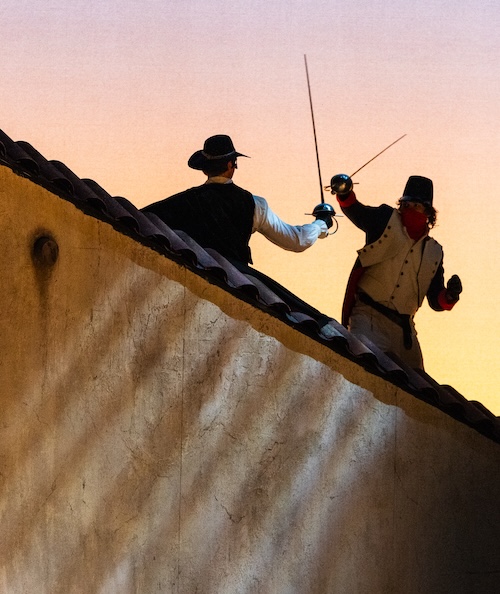
Octavio Moreno is superb as the brutal mayor Octavio Rivera y Moncada. With his dark baritone and fine acting he captures the full range and depth of his cruelty. The final scene between him and de la Vega as they fight to the death is one of the high points of the opera.
For some much needed comic relief, soprano Arianna Rodriguez as Luisa and baritone Armando Contreras as Sergeant José Maria Gomez are an absolute delight as they flirt and tease one another and eventually fall in love.
Rounding out the cast is mezzo-soprano Sishel Claverie as Toypurina, who helped raise de la Vega and whom he calls Nana, and baritone Stephen Pace as Zazueta, who teaches de la Vega how to fight and turns him into a master swordsman.
The Utah Opera Chorus members, playing the townspeople, are once again in excellent voice, singing with depth and definition. Members of the Utah Symphony, under the baton of conductor Alex Amsel, play edwith well-defined articulation and expression.
Stage director David Radamés Toro’s pacing lets the action onstage unfold briskly without any awkward lapses, even in the numerous scene changes in each of the two acts.
Sets by Liliana Duque Piñeiro and costumes by Ulises Alcala capture the time period of Spanish California vividly with their designs.
The opera is sung in Spanish and English with bilingual supertitles.
Utah Opera’s Zorro runs through October 18. utahopera.org
Leave a Comment