A night of mixed rewards with Tao’s double-barreled return to Utah Symphony
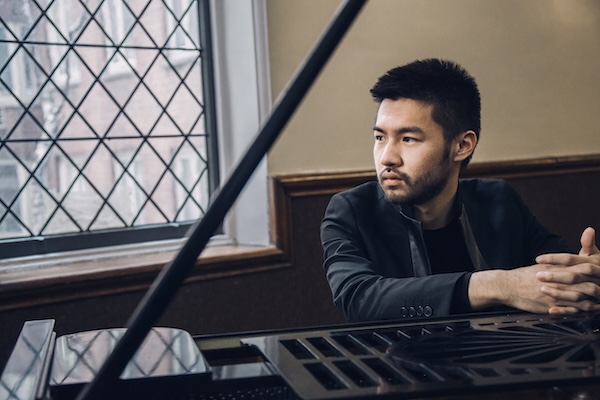
Conrad Tao, is no stranger to Utah Symphony audiences. The pianist debuted with the orchestra as a teenager in 2010 in Rachmaninoff’s Rhapsody on a Theme of Paganini, when he replaced an ailing Horacio Gutiérrez on short notice. Since then he has returned to Abravanel Hall numerous times as a soloist.
This weekend’s Utah Symphony program brought Tao’s debut with the orchestra as both pianist and conductor, in a program featuring two works by Mozart, the Piano Concerto No. 20 in D minor and the Symphony No. 40 in G minor.
At Friday’s performance, one could tell once again that Tao is an accomplished and talented pianist; however, his flamboyant style doesn’t translate well to Mozart, where clarity and precision are essential in conveying the subtle nuances in the music.
In the concerto, the first two movements fared the best. Tao’s articulation emphasized the somber tone in the opening movement without being overplayed, and he achieved a nice balance between the piano and the orchestra. The same held true for the middle movement. The opening and closing sections flowed with graceful elegance, while Tao and the orchestra underscored the restless energy of the stormy middle section with fervent, impassioned playing.
The main theme from the third movement Rondo suffered from Tao’s impulsive and overly dramatic playing. His choice of tempo felt rushed, his playing was erratic and too impetuous and failed to capture the melodic flow of the music. There were some worthy lyrical moments in the contrasting themes yet the entire movement felt out of place to the rest of the concerto because of his frenzied, unrefined playing.
Tao managed to do an efficient job conducting from the keyboard. With his minimal gestures, he did manage to cue the orchestra at critical points and it turned out to be a solid collaborative effort between him and the ensemble.
Tao also played an encore, his own transcription of Over the Rainbow. The arrangement was jazzy and flashy, which suited his gregarious style of playing, showing that he is much more at home in this kind of showoffy music than with Mozart.
The performance of the G minor Symphony after intermission was also problematic, in part due to numbers. Mozart scored the symphony for a small ensemble of woodwinds, horns and strings. This performance employed almost the full complement of the orchestra’s string section, which was too large, creating an imbalance between them and the winds. Consequently, the Classical intimacy of the music was totally lost. Also, Tao’s exaggerated direction missed the nuances in the music and resulted in a lack of clarity and expression.
There were a few memorable moments. In the Andante Tao allowed the strings to play with clean phrasing and charming lyricism. And he brought out the rhythmic vitality of the third movement minuet without overdoing it. But the outer movements were muddled and there was a lack of cohesion in the playing as well as his direction that made the music sound flat and one-dimensional.
The concert opened with the American-Canadian composer Linda Catlin Smith’s Nuages, an atmospheric piece for full orchestra that explores instrumental colors and orchestral textures.
The work opens with shimmering strings, supported by the woodwinds, that slowly shift harmonies while also adding textural layers as other instruments enter and drop out. The ever-changing soundscape is what propels the work forward and engulfs the listener in a wispy, ethereal world of vivid orchestral imagery.
Smith’s piece also received piece Tao’s best conducting Friday. He captured the subtle intricacies of the ever-changing score and brought definition and a cohesive flow to the music, allowing it to unfold seamlessly.
The program will be repeated 7:30 p.m. Saturday. utahsymphony.org
Leave a Comment