Love is strong in Ballet West’s wide-ranging program of premieres
Ballet West danced through flirtations, love, loss, and breakups Friday night at the Capitol Theatre with “Rolling with the Stones”. This mixed-repertoire program featured five contemporary ballets that are all new to the company.
The program opened with Ulysses Dove’s Dancing on the Front Porch of Heaven, a stark and moving reflection on loss. Six dancers begin in a circle, asymmetrically lit, shifting through shadow and light as they spread over the stage.
Dove’s choreography focuses heavily on repetition of form with slow and subtle transformations. The opening section emphasizes angularity, with blunt raised arms and feet in fourth position, which highlights the diagonal lines of the dancers. The second section, a men’s pas de deux, melts into soft, curved shapes, providing a refreshing contrast.
In the third section, Dominic Ballard exhibited exceptional control and precision through a series of complex recurring turns. Although the dancers come together in a group throughout the choreography, echoed segments when they perform similar movements in distant parts of the stage concentrated the feelings of loneliness and separation.
Dove choreographs a very compact turning style, keeping the arms, legs, and feet close to the body, bringing the energy inward. This differed from moments in the fourth section when dancers would alternately lean into and away from each other, offering breathless moments counterbalanced by their partner.
The piece is set to Cantus in Memory of Benjamin Britten by Arvo Pärt, with the music being repeated three times, with additional sections of just the pealing bell. Designed to build solemnity, at times it felt disconnected from the choreography.
The middle section of the program featured three short pas de deux, each capturing a different emotion and physical tone. In Christopher Wheeldon’s Je Ne T’Aime (pas de deux), Nicole Fannéy and Dominic Ballard portray a couple breaking up. Wheeldon keeps the center point of his focus in the space between the two dancers, so even when they move away, the tension snaps them back to orbit each other. They brought a sharp edge to their dancing, where every gesture carried meaning, whether it was a subtle reaching hand for a person that was no longer there, to a series of quarter turns as Fannéy avoided facing Ballard.
The dancers were joined onstage by vocalist Jin-Xiang Yu and pianist Emily Barrett in Kurt Weill’s Je Ne T’aime, whose alternating intensity and fragility complemented the dancers’ energy.
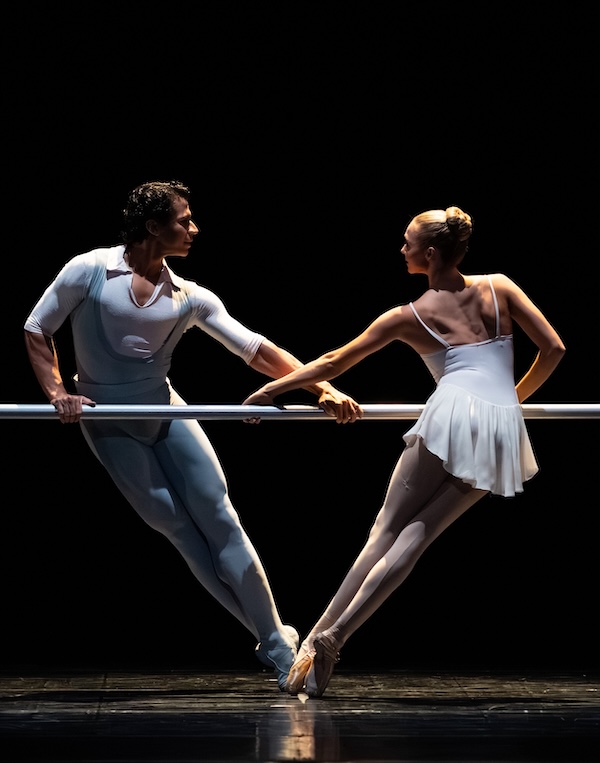
Rylee Ann Rogers and Hadriel Diniz followed in Three Preludes by Ben Stevenson, a piece showing the early moments of a romantic relationship. In the first section, Stevenson uses the ballet barre as a prop to delineate the personal space of each dancer, letting them travel under, over, and on top of the barre before it is removed.
This section extensively uses reflected movement between the two dancers, making them almost a mirror image of each other.
Rogers and Diniz stretched and shifted in unison with precise articulation, subtly changing their timing and gestures to match each other.
Diniz was confident and secure in the lifts throughout the piece, sliding a standing Rogers on top of the barre in the first section, while she explored a variety of balanced forms and shapes in the second section. Her lightness, combined with his stability, was a winning combination for the challenging lifts and turns throughout the piece.
Music director Jared Oaks joined them onstage to play Three Preludes by Sergei Rachmaninoff. His technique beautifully supported the hesitance, surprise, and joy of their dance.
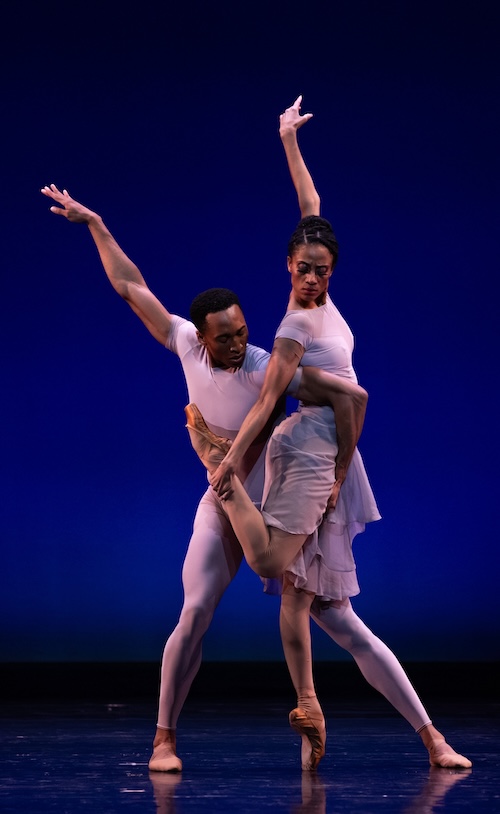
The third pas de deux, Christopher Wheeldon’s This Bitter Earth, was an exquisite vehicle for Katlyn Addison and Loren Walton, whose bodies were perfect for the long, sweeping motions of the choreography. The physicality of the choreography has a high amount of tension and very little release, as the dancers move together across the stage in a series of turns and lifts that fall from side to side. Set to Dinah Washington’s This Bitter Earth and Max Richter’s On the Nature of Daylight, their shifting motions were elegant, unhurried, and lush.
The evening closed with Christopher Bruce’s Rooster, a high-energy piece set to eight songs by The Rolling Stones. From the opening steps, Bruce’s choreography tends toward exaggeration, with the dancers strutting and scratching like roosters, and persistently adjusting their neckties and fixing their hair.
The choreography worked hard to reflect each individual song, sometimes through the energy and style and other times through hand gestures meant to signify the lyrics. Although the piece is set for five male and five female dancers, this work really showcases the men, with the women serving primarily as background dancers.
Jonas Malinka-Thompson was an explosion of energy in “Not Fade Away” through a series of turns as he moved toward his partner then fell, landing on his back on the floor to continue dancing. In “Paint it Black” William Lynch had a solo more grounded in classical ballet as his elegant turns contrasted with the 1960’s dance club gyrations of the women.
By the end of the piece some of the gestures grew unintentionally silly, with the men galloping around with pointed fingers on their heads like devil horns during “Sympathy for the Devil,” coupled with the repetition of rooster strutting and tie adjusting.
Ballet West’s “Rolling with the Stones” continues through November 14. balletwest.org
Leave a Comment